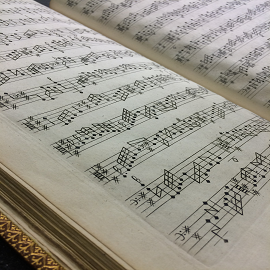
Item 320 - Wiegenlied

Title and statement of responsibility area

Title proper

Wiegenlied

General material designation

    Parallel title

    Other title information

    Song with piano accompaniment and violin obl.

    Title statements of responsibility

    Title notes

    Level of description

    Item

    Reference code

    CA MDML 015-2-320

    Edition area

    Edition statement

    Edition statement of responsibility

    Class of material specific details area

    Statement of scale (cartographic)

    Statement of projection (cartographic)

    Statement of coordinates (cartographic)

    Statement of scale (architectural)

    Issuing jurisdiction and denomination (philatelic)

    Dates of creation area

    Date(s)

    Physical description area

    Physical description

    Publisher's series area

    Title proper of publisher's series

    Parallel titles of publisher's series

    Other title information of publisher's series

    Statement of responsibility relating to publisher's series

    Numbering within publisher's series

    Note on publisher's series

    Archival description area

    Name of creator

    (1906-1985)

    Biographical history

    German conductor Wilhelm Brückner-Rüggeberg (Karl Aurel) was born into a family of performers, both actors and singers, in Stuttgart. Trained in Munich, he began his musical career in 1929 as an assistant (Hilfs-Solorepetitor) to conductor Hans Knappertsbusch at the Staatsoper there. In 1934 he succeeded Herbert Von Karajan as Kapellmeister in Ulm, but was arrested for having helped fellow musician, Felix Wolfes, a Jew, to emigrate to France and then the USA. He was forbidden to conduct for several years. In 1937 Wilhelm Furtwangler, conductor of the Berlin Philharmonic Orchestra, invited him to conduct a complete Beethoven cycle. In 1938 he was allowed to join the Hamburg Staatsoper and soon became “Erster Kapellmeister” (choir director). Beginning in 1940 he became director of the Lehrergesangsverein (Teachers’ Choir) in Hamburg; during his time there he conducted more than 700 concerts for schoolchildren. He started to teach conducting in 1943 but was mobilized in 1944. After the war, he was one of the founders of the Hochshule für Musik und Theater in Hamburg and later became a full professor there. By 1970 he had conducted more than 2,000 performances of the Staatsoper there. From 1956 and 1960, he made several recordings conducting Kurt Weill’s works including some with Lotte Lenya as a soloist. He was known particularly for his direction of pieces by Handel such as oratorios. He was often invited to be a guest conductor, many times in South America. He composed at least one song, Seemansliebe, a walz, which was signed with the pseudonym “Karl Aurel,” according to the Library of Congress Catalog of copyright entries, 3rd series (1962). He had five children with his wife mezzo-soprano Ludmilla Schirmer.

    Custodial history

    Scope and content

    Notes area

    Physical condition

    Immediate source of acquisition

    Arrangement

    Language of material

      Script of material

        Location of originals

        Availability of other formats

        Restrictions on access

        Terms governing use, reproduction, and publication

        Finding aids

        Associated materials

        Related materials

        Accruals

        General note

        Two copies; one personally autographed by composer.

        Alternative identifier(s)

        Accession no.

        D320

        Standard number

        Standard number

        Access points

        Subject access points

        Place access points

        Name access points

        Genre access points

        Control area

        Description record identifier

        Institution identifier

        Rules or conventions

        Status

        Level of detail

        Dates of creation, revision and deletion

        Language of description

          Script of description

            Sources

            Accession area