
McGill Libraries
McLennan Library Building3459 rue McTavish
Montreal, Quebec
H3A 0C9
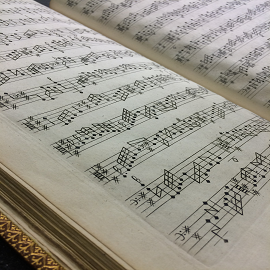
Michael William Balfe was born on May 5, 1808, in Dublin, Ireland, the son of a dancing master.
He was an Irish composer and singer. He studied the violin as a child and his first job was in the orchestra of London's Drury Lane Theatre. Possessing a fine baritone voice, he made his operatic debut in 1823 and came to prominence as Figaro in an 1827 Paris production of Rossini's "The Barber of Seville" under the composer's supervision. He then performed in Italy for eight years, culminating in an engagement at La Scala. Balfe's singing was praised, but his habit of "improving" old operas by adding his arias caused some resentment among audiences. His first opera, "I Rivaldi di se stessi," was performed in Palermo in 1829. After more successes in this field, Balfe returned to London in 1835, where he became the leading composer of English-language opera with "Siege of Rochelle" (1835), "The Maid of Artois" (1836) and "Catherine Grey" (1837). Balfe was known for his talent in creating melodies and understanding British musical preferences. He skillfully combined Italian tradition with English ballad style. Many of his arias became popular songs in their day. "The Bohemian Girl," his most successful opera, had a record 100-night run at Drury Lane and was performed in major cities worldwide, being the only one of his 28 operas that is still performed today. Balfe worked as a composer and singer until 1846 when he became the conductor of Her Majesty's Theatre. He also received commissions from La Scala and the Paris Opera and was honoured with France's Legion of Honor. In 1864, Balfe retired to his estate in Hertfordshire and lived there as a gentleman farmer. A cenotaph for the composer was placed in Westminster Abbey in 1882, and there is a stained-glass window dedicated to him in Dublin's St. Patrick's Cathedral. Balfe is celebrated for his opera "The Bohemian Girl" (1843), a colourful melodrama about a group of gypsies who raise a nobleman's daughter as their own. The soprano aria "I Dreamt I Dwelled in Marble Halls" from this opera has become a standard recital piece.
He died on October 20, 1870, in Ware, Hertfordshire, England.