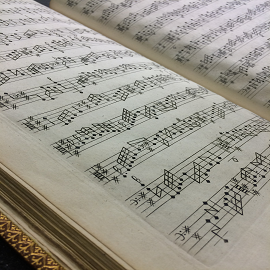
Item 689 - Ciel Clair, Ciel Gris (Sunrise, Sunset), from "Fiddler on the Roof"

Title and statement of responsibility area

Title proper

Ciel Clair, Ciel Gris (Sunrise, Sunset), from "Fiddler on the Roof"

General material designation

    Parallel title

    Other title information

    Song with piano accompaniment

    Title statements of responsibility

    Title notes

    Level of description

    Item

    Reference code

    CA MDML 015-2-689

    Edition area

    Edition statement

    Edition statement of responsibility

    Class of material specific details area

    Statement of scale (cartographic)

    Statement of projection (cartographic)

    Statement of coordinates (cartographic)

    Statement of scale (architectural)

    Issuing jurisdiction and denomination (philatelic)

    Dates of creation area

    Date(s)

    Physical description area

    Physical description

    Publisher's series area

    Title proper of publisher's series

    Parallel titles of publisher's series

    Other title information of publisher's series

    Statement of responsibility relating to publisher's series

    Numbering within publisher's series

    Note on publisher's series

    Archival description area

    Name of creator

    (1928-2010)

    Biographical history

    Composer Jerry Bock is best known as half of an award-winning musical team of Bock and Harnick. Born in New Haven, Connecticut, and raised in Flushing, New York, he got his start in musical theatre in high school after childhood piano lessons. It was in his senior year at the University of Wisconsin in Madison that his talent became evident: the musical he wrote for a student club, “Big as Life,” about the Paul Bunyan legend, went on a state tour and later had a run in Chicago. He and his classmate collaborator, Lawrence Holofcener, spent three summers gaining experience at Taminent Playhouse in the Poconos. Back in New York, Bock and Holofcener made their Broadway debut in 1955 with songs they wrote for the musical “Catch a Star.” There followed “Mr. Wonderful,” written for Sammy Davis, Jr., which ran for over 300 performances, then “Ziegfield Follies of 1956,” which flopped. Bock met a new partner in lyricist Sheldon Harnick. Their first effort, “The Body Beautiful," was not a success, but director George Abbott and producer Hal Prince nevertheless hired them to work on a musical biography of New York Mayor Fiorello La Guardia. For this, in 1959 they won the so-called “triple crown”: a Tony (tied with Richard Rogers for “The Sound of Music”), the New York Drama Critics’ Award, and the Pulitzer Prize for drama. The team went on to compose many other musicals together, the most famous of which was “Fiddler on the Roof,” which won them another Tony in 1964. They were both inducted into the Songwriters’ Hall of Fame in 1972, and in 1990 the institution gave them the Johnny Mercer Award on the 25th anniversary of the opening of “Fiddler on the Roof” on Broadway. That same year they were inducted into the Theater Hall of Fame. In 1997 the BMI, the performing rights organization, instituted an annual Jerry Bock Award for Excellence in Musical Theater for a composer and lyricist of a project developed in the BMI Lehman Engel Musical Theater Workshop. In a bittersweet coincidence, Bock died just ten days after he had spoken at the funeral of Joseph Stein, the author of “Fiddler on the Roof.”

    Custodial history

    Scope and content

    Notes area

    Physical condition

    Immediate source of acquisition

    Arrangement

    Language of material

      Script of material

        Location of originals

        Availability of other formats

        Restrictions on access

        Terms governing use, reproduction, and publication

        Finding aids

        Associated materials

        Related materials

        Accruals

        General note

        Lyrics in French and English, two copies.

        Alternative identifier(s)

        Accession no.

        D689

        Standard number

        Standard number

        Access points

        Subject access points

        Place access points

        Name access points

        Genre access points

        Control area

        Description record identifier

        Institution identifier

        Rules or conventions

        Status

        Level of detail

        Dates of creation, revision and deletion

        Language of description

          Script of description

            Sources

            Accession area