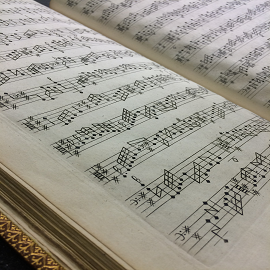
Item 170 - Baia, from the film The three caballeros

Title and statement of responsibility area

Title proper

Baia, from the film The three caballeros

General material designation

    Parallel title

    Other title information

    Song with piano accompaniment

    Title statements of responsibility

    Title notes

    Level of description

    Item

    Reference code

    CA MDML 015-2-170

    Edition area

    Edition statement

    Edition statement of responsibility

    Class of material specific details area

    Statement of scale (cartographic)

    Statement of projection (cartographic)

    Statement of coordinates (cartographic)

    Statement of scale (architectural)

    Issuing jurisdiction and denomination (philatelic)

    Dates of creation area

    Date(s)

    Physical description area

    Physical description

    Publisher's series area

    Title proper of publisher's series

    Parallel titles of publisher's series

    Other title information of publisher's series

    Statement of responsibility relating to publisher's series

    Numbering within publisher's series

    Note on publisher's series

    Archival description area

    Name of creator

    (1903-1964)

    Biographical history

    Samba legend Ary Barroso was the first Brazilian to be nominated for an Oscar. The multi-faceted musician was born in Ubá in Minas Gerais, the son of poet, singer and lawyer Joao Evangelista, but was orphaned at the age of seven. Raised by his grandmother and aunt, he was sent for piano lessons at age ten and disciplined to practice three hours daily. In 1920 he headed to Rio for training in law, but he soon spent an inheritance from his uncle and had to begin to earn his living by playing for dance-hall orchestras. His talent became obvious when he began composing, as did his versatility when working as a radio announcer (beginning in 1933), writer, humorist, reporter, producer, emcee, interviewer and even soccer commentator. One of the most influential pre-Bossa Nova composers in Brazil in the late 1920s and 1930s, he changed the face of Brazilian samba, developing the genres of samba-cancão and samba exaltacão. His songs were recorded by many famous singers, including his friend Carmen Miranda and João Gilberto. He wrote more than 60 songs and tunes for Rio’s famous Carnaval festival, and 52 of his works were used in movies. His 1939 piece “Aquarela do Brasil” was used in the 1942 Disney film “Saludos Amigos” and has become one of the 20 most recorded songs of all time. He did manage to finish law school and married the daughter of the boarding house where he lodged. Though he didn’t win the Oscar for which he was nominated in 1945, he did get a Merit award from the Academy, and in 1955 the National Order of Merit from the Brazilian government.

    Custodial history

    Scope and content

    Notes area

    Physical condition

    Immediate source of acquisition

    Arrangement

    Language of material

      Script of material

        Location of originals

        Availability of other formats

        Restrictions on access

        Terms governing use, reproduction, and publication

        Finding aids

        Associated materials

        Related materials

        Accruals

        Alternative identifier(s)

        Accession no.

        D170

        Standard number

        Standard number

        Access points

        Subject access points

        Place access points

        Name access points

        Genre access points

        Control area

        Description record identifier

        Institution identifier

        Rules or conventions

        Status

        Level of detail

        Dates of creation, revision and deletion

        Language of description

          Script of description

            Sources

            Accession area